Sourcing a reliable Nonwoven Pillow Cover requires more than comparing unit prices. The fabric may look simple, yet fiber type, bonding method, and seam strength affect comfort, durability, and waste. This guide presents seven practical tips for evaluating suppliers, specifications, samples, and production controls.
Industry data shows why this category deserves careful attention. Grand View Research valued the global nonwoven fabrics market at approximately USD 53.5 billion in 2022. Its report also projects continued growth through 2030, supported by hygiene, medical, filtration, and consumer applications. Smithers’ The Future of Global Nonwovens to 2029 identifies sustainability, lightweight structures, and advanced material performance as important market directions. These trends influence pillow-cover sourcing, even when the product serves hospitality, furniture, or protective packaging.
Supplier claims still require verification. Ask for fiber composition, basis weight, tensile-strength results, and colorfastness records. ISO 9073 test methods can help compare nonwoven properties consistently. A sample should be handled, washed when relevant, and checked under bright light. Look for loose fibers, uneven edges, weak closures, and odor after unpacking. Small defects often become costly at scale.
Price is only one signal. A low quotation may hide inconsistent rolls, unclear tolerances, or unreliable delivery. Request production photos, inspection procedures, and traceable batch information. Environmental claims need evidence, not attractive wording. Recycled content, packaging reduction, and factory certifications should be documented. No checklist is perfect. I have found that practical testing sometimes challenges a supplier’s polished presentation. The following seven tips help buyers make more informed, measurable, and responsible decisions.
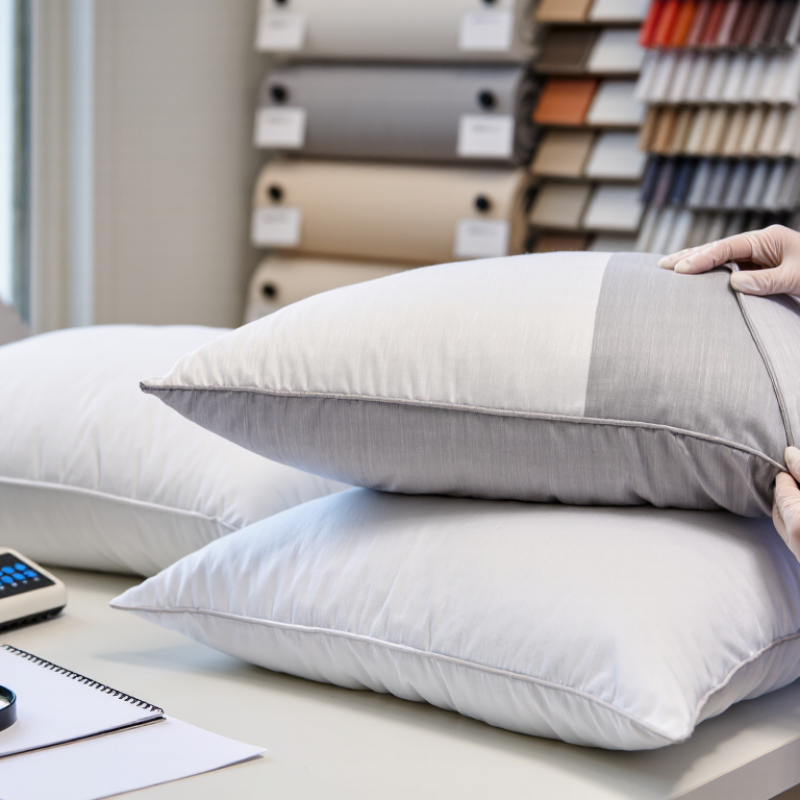
Before requesting samples, define what the pillow cover must achieve. Is it for hotel turnover, medical support, travel use, or home protection? These needs change the fabric weight, softness, closure, and barrier level. A disposable cover may need liquid resistance, while a reusable cover needs tear strength and stable washing performance. Grand View Research valued the global nonwoven fabrics market at about USD 53.7 billion in 2022, with projected growth through 2030. This expanding market offers choices, but more options can create confusion.
Tip: Write measurable targets.
Specify basis weight, commonly in grams per square meter, plus tensile strength and elongation. Ask suppliers for test methods, not only attractive numbers. For liquid protection, request hydrostatic pressure or spray-rating results. For comfort, check air permeability, surface feel, lint release, and noise during movement. ISO 9073 test methods are widely used for nonwoven tensile and basis-weight evaluation. For reusable designs, define wash temperature, cycle count, shrinkage, and seam durability. A cover that survives ten washes may fail after thirty. That difference matters.
Tip: Test the finished cover.
Do not assess fabric alone. Place it over the actual pillow size and inspect corners, elastic recovery, zipper movement, and fit after laundering. INDA’s nonwoven industry reporting repeatedly highlights performance testing and end-use specification as critical purchasing controls. I would also request samples from two production lots. Color and softness can shift slightly. That is easy to overlook. Record failures honestly, even when the sample feels acceptable, because a low-cost cover becomes expensive when returns, replacement labor, and user complaints accumulate.
Material selection should begin with contact feel, not the lowest quotation. Spunbond polypropylene offers strength, low cost, and a crisp surface. Spunlace feels softer, but it usually costs more and absorbs moisture. Meltblown provides fine filtration, yet it is less suitable for repeated handling. Grand View Research reported that the global nonwoven fabrics market reached approximately USD 53.5 billion in 2022. Its report also projected a 7.8% compound annual growth rate through 2030. This growth increases material choices, but it can also create inconsistent specifications.
Weight changes both performance and appearance. For disposable pillow covers, 20–30 gsm can support light protection and efficient packing. Around 40–60 gsm feels more substantial and resists tearing during hotel or healthcare handling. Always request a measured gsm result, not only a supplier’s stated range. Surface finish matters too. Thermal calendering creates a smoother, denser face, while embossing can add texture and reduce visible creasing. A hydrophilic finish may improve moisture spreading, although it can weaken some dry-touch expectations. Smithers’ nonwovens market analysis identifies hygiene and medical applications as major demand drivers, where softness, cleanliness, and barrier performance are closely evaluated.
Test actual samples under pressure. A perfect specification rarely exists. I still test both sides, because one surface may feel noticeably rougher after finishing. Check seam strength, odor, lint release, and package compression before approving production.
For nonwoven pillow covers, supplier evaluation should begin with measurable quality controls, not attractive samples. Grand View Research valued the global nonwoven fabrics market at about USD 53.5 billion in 2022. This scale increases supplier choice, but it also makes consistency harder to verify.
Request recent inspection records for fabric weight, thickness, tensile strength, color difference, and seam performance. A reliable factory should define sampling plans, acceptable quality limits, and corrective actions for failed lots. Check whether operators record results digitally or only sign paper forms. Small details matter. Ask for lot traceability from raw fiber to packed covers. Then request production samples from three separate batches. One perfect sample proves little.
Production capability needs equal attention. Inspect carding, bonding, cutting, sewing, printing, and packing equipment. Compare stated capacity with monthly schedules and actual machine hours. Smithers’ global nonwovens market analysis identifies hygiene and household applications as major demand areas, increasing pressure on flexible, repeatable production. A supplier should explain maintenance routines, backup equipment, and peak-season capacity. Do not accept “we can scale quickly” without evidence. Review defect rates, rework records, and shipment history. Factory tours can mislead. A clean showroom is not a quality system. Even experienced buyers can overvalue polished presentations, so independent testing remains worth the cost.
This weighted evaluation model emphasizes quality control and production capability when comparing nonwoven pillow-cover suppliers. Quality-system controls, process consistency, material traceability, and corrective-action records should be verified through documentation, samples, and on-site or third-party audits.
7 Tips for Sourcing Nonwoven Pillow Covers
Request a production sample, not just a fabric swatch. Check its weight, thickness, hand feel, color, and odor. Then inspect a finished cover: pull the seams gently, test the closure, and wash it if the product will be washable. Small details matter. Record the sample’s specifications so bulk production can be compared against the same benchmark. One sample is not proof of consistent output; ask how the supplier controls batch variation.
Verify certificates by checking their validity, scope, and covered facility or product. Ask for test reports that match the material and intended use, rather than accepting a generic certificate. Grand View Research valued the global nonwoven fabric market at USD 53.5 billion in 2023 and projected a 6.2% compound annual growth rate from 2024 to 2030. Textile Exchange’s Materials Market Report 2024 estimated global fiber production at 124 million tonnes in 2023. These figures describe a large, varied supply base, not any supplier’s quality. Ask for customization details in writing, including dimensions, color, printing, packaging, and any added charges. Confirm minimum orders for each size and color, plus sample, lead-time, and reorder quantities. Ask for proof. A low minimum may still mean higher unit costs or limited material choices. Recheck the terms before approving production.
| Tip | What to Verify | What to Request | Useful Purchasing Record |
|---|---|---|---|
| 1. Define the product and material | Confirm whether the item is a removable pillow cover or a disposable protective cover. Specify the nonwoven fiber, construction, color, and any coating or treatment; these affect feel, strength, and intended use. | A written specification identifying the material (such as polypropylene or polyester), construction, finish, and intended application. | Approved product specification with a revision date and material description. |
| 2. Verify samples before ordering | Check dimensions, seams, closure, appearance, odor, and performance against the intended use. Evaluate the sample under the handling or care conditions relevant to your product. | A pre-production sample made to the proposed specification, plus a sample approval form. If testing is needed, agree on the test method and pass criteria before production. | A signed or otherwise documented “golden sample” approval, with dated photos and recorded measurements. |
| 3. Check dimensions and construction | Clarify finished dimensions and how they are measured. Specify tolerances, seam placement, closure type, and whether the measurements refer to the flat cover or the usable opening. | A dimensioned drawing or specification showing measurement points, tolerances, seam details, and closure requirements. | A measurement checklist to use during sample approval and incoming inspection. |
| 4. Validate certifications and claims | Confirm that any certificate or test report is current and applies to the offered material, product, facility, and intended market. For example, OEKO-TEX STANDARD 100 relates to testing for harmful substances within its stated scope; it is not a general guarantee of every product attribute. ISO 9001 concerns a quality-management system, not product certification. | Copies of relevant certificates or reports, scope details, validity dates, and confirmation of which supplied components they cover. Check documents with the issuing organization where appropriate. | A compliance file listing each requested claim, supporting document, scope, and verification status. |
| 5. Specify customization clearly | Confirm available sizes, colors, printing, labels, closures, and packaging. Ask whether custom colors or artwork require separate setup, sampling, or minimum quantities. | A written customization brief with artwork files, color references, label content, packaging details, and approval steps. | An approved artwork proof and final configuration sheet attached to the purchase order. |
| 6. Confirm minimum orders and total costs | Ask for the minimum order quantity (MOQ) by size, color, and customization option. Clarify sample, tooling or setup, packaging, freight, payment, and any charges for changes. MOQ and pricing vary by supplier and specification. | A quotation showing quantity breaks, MOQ, currency, included and excluded costs, payment terms, and quote validity. | A landed-cost comparison using the same specification, order quantity, and delivery basis for each quotation. |
| 7. Agree on quality checks and delivery terms | Set measurable inspection criteria for dimensions, workmanship, appearance, labeling, and packaging. Confirm production lead time, inspection timing, shipping method, and the process for handling nonconforming goods. | A quality-control plan, production timeline, packing details, and written terms for inspection, defect reporting, and corrective action. | A purchase order that references the approved specification, sample, inspection criteria, delivery schedule, and agreed remedies. |
Note: Set acceptance limits and testing requirements to match the product’s intended use, applicable regulations, and your own quality standards.
Nonwoven pillow covers look inexpensive until landed cost is calculated. Start with fabric weight, cover dimensions, stitching, printing, packaging, inspection, and tooling. Add every item. Smithers’ The Future of Nonwovens to 2028 valued the global market at about $53.5 billion in 2023, showing how material demand can affect pricing. Ask suppliers for fiber composition, GSM tolerance, minimum order quantity, and defect allowances. Request separate quotes for standard and customized covers. Then compare the total cost per usable piece, not only the factory price. My early estimates were too optimistic because rejected units were ignored.
Confirm production lead time in writing. Separate sampling, material purchasing, sewing, inspection, and packing days. Add a buffer for holidays and rework. World Bank’s 2023 Logistics Performance Index shows timeliness remains a core logistics measure, not a minor detail. Choose the suitable Incoterm, then compare sea, rail, and air freight. UNCTAD’s Review of Maritime Transport reports that ships carry over 80% of global merchandise trade by volume. That scale does not guarantee your booking. Check carton size, pallet limits, dimensional weight, port congestion, customs documents, and destination delivery fees. Freight quotes often exclude local charges. Small errors become expensive. A pilot order can reveal actual packing volume and transit time, although it may delay launch. Recheck the spreadsheet after sampling; the first version is rarely complete.
Define the intended use, such as hotel turnover, medical support, travel, or home protection. Set targets for fabric weight, softness, closure, barrier level, strength, and washing performance. Write measurable requirements. Vague comfort claims can cause trouble later.
Request basis weight, tensile strength, elongation, air permeability, and lint release. For liquid resistance, ask for hydrostatic pressure or spray-rating results. Also check surface feel and noise during movement. Quietness matters at night.
Test the finished cover on the actual pillow size. Inspect the corners, elastic recovery, closure movement, and overall fit. Wash reusable covers before approval. A fabric can perform well alone but fail when sewn.
Specify the wash temperature, cycle count, shrinkage limit, and seam durability. Check the cover after ten washes, then consider longer testing. Ten washes may look fine. Thirty could expose hidden weakness.
Request a finished production sample, not only a fabric swatch. Check weight, thickness, color, odor, hand feel, seams, and closure strength. Pull the seams gently. Small defects become expensive at scale.
No. Ask for samples from at least two production lots. Compare color, softness, weight, and dimensions against the same records. One sample proves very little. Batch variation is easy to overlook.
Check certificate validity, scope, covered facility, and covered product. Request reports matching the material and intended use. Do not accept a generic document without checking its details. I might still miss something.
Confirm dimensions, color, printing, packaging, added charges, and minimum orders in writing. Check quantities separately for each size and color. Also confirm sample timing, production lead time, and reorder quantities. A low minimum order may carry higher unit costs. That deserves another review.
Sourcing the right Nonwoven Pillow Cover starts with clearly defining your requirements, including intended use, durability, softness, breathability, appearance, and hygiene performance. Compare different nonwoven materials, fabric weights, textures, and surface finishes to find the best balance between comfort, protection, and cost. It is also important to assess each supplier’s quality control procedures, production capacity, equipment, and ability to maintain consistent standards across large orders.
Before making a decision, request samples to evaluate construction, fit, strength, and overall finish. Confirm relevant certifications, customization options, packaging requirements, and minimum order quantities in advance. Finally, calculate the total purchasing cost by considering unit price, tooling or customization fees, lead times, shipping methods, import charges, and potential delays. A careful comparison of product performance, supplier reliability, and overall logistics will help you select a suitable Nonwoven Pillow Cover while reducing quality risks and improving purchasing efficiency.

HG NONWOVEN