Global sourcing of Nonwoven Wet Tissue is no longer a simple price comparison. Buyers must evaluate fiber composition, liquid formula, converting quality, packaging, and compliance together. A weak decision can leave cartons leaking in a humid warehouse or sheets tearing during use.
Industry data shows why this category deserves careful research. Grand View Research estimates that the global wet wipes market reached approximately USD 21 billion in 2023, with continued growth expected through 2030. Smithers’ “The Future of Global Nonwovens to 2028” also identifies hygiene applications as an important demand area for nonwoven materials. These reports suggest strong commercial potential. They do not guarantee every supplier is dependable.
Start with measurable specifications. Confirm basis weight, tensile strength, absorbency, sheet dimensions, and lotion loading. Ask whether the substrate uses polyester, viscose, lyocell, polypropylene, or a blend. Request recent laboratory results, not only a product brochure. For skin-contact products, review microbiological testing, preservative challenge testing, and ingredient documentation. Independent audits can provide useful evidence, but they are not a substitute for batch control.
Sustainability requires equal attention. Verify renewable-content claims, plastic content, packaging materials, and disposal instructions. “Flushable” must never be accepted without recognized testing and market-specific evidence. Regulations differ across countries. That detail is often underestimated.
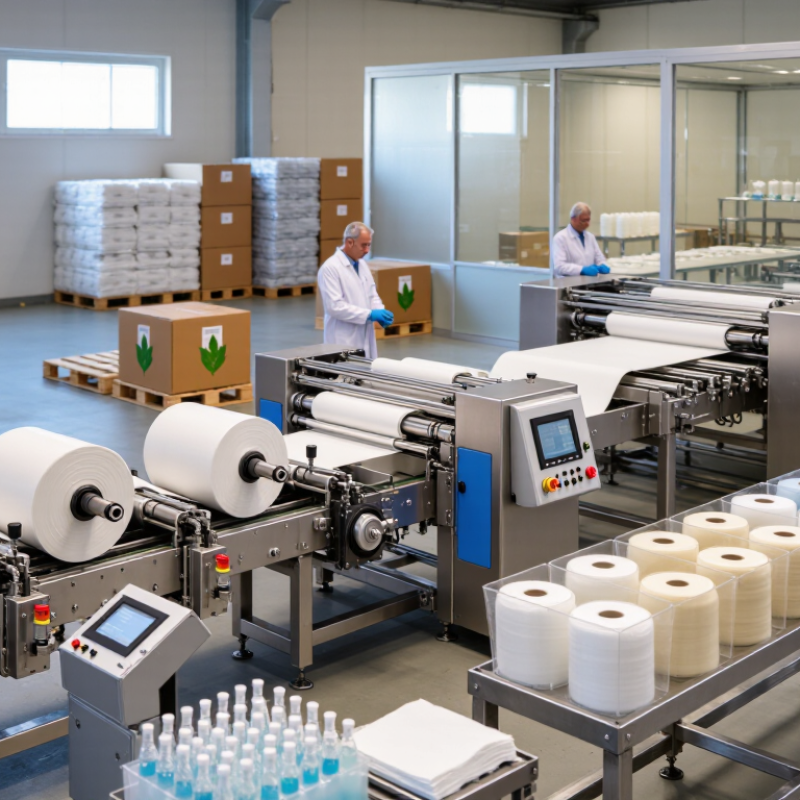
A practical sourcing review should include factory capacity, sample approval, traceability, lead times, and contingency planning. Visit the production line when possible. Watch the unwinding roll, sealing temperature, and pallet condition. Small observations matter.
There is no perfect specification. Buyers should challenge attractive claims, compare total landed cost, and document every decision before signing a global supply agreement.
What Is Nonwoven Wet Tissue and Why Does Material Choice Matter?
Nonwoven wet tissue is a soft sheet made from bonded fibers, then saturated with a water-based lotion. The fibers may be plant-based, synthetic, or blended. It starts with fibers. Their structure controls softness, absorbency, strength, and lint release. A dense sheet feels smooth, but it may absorb lotion slowly. A loose sheet absorbs quickly, yet it can tear during wiping.
Material choice matters because each use creates different demands. Facial tissue needs a gentle surface and low lint. Household cleaning tissue needs stronger wet tensile strength. Personal care tissue requires skin-compatible ingredients and reliable microbial protection. Small differences matter. Basis weight, fiber length, bonding method, and lotion viscosity can change the user experience. In practical sourcing work, I would request dry and wet strength data, absorbency results, pH testing, and preservative compatibility records. A supplier’s sample alone is not enough.
Global sourcing also requires careful verification. Ask for raw material traceability, batch records, safety documentation, and independent laboratory reports. Requirements can differ between destination markets, especially for labeling, allergens, preservatives, and disposal claims. Do not assume “flushable” or biodegradable means universally accepted. Not always. Pilot production can reveal problems that samples hide, such as edge curling, lotion separation, or unpleasant odor after storage. I have seen specifications become too ambitious, with softness, strength, low cost, and rapid biodegradation demanded together. That combination may need compromise. A clear material specification helps buyers compare suppliers fairly and reduce quality surprises.
How to Choose Nonwoven Wet Tissue for Global Sourcing?
What Is Nonwoven Wet Tissue and Why Does Material Choice Matter?
Nonwoven wet tissue is a disposable wipe made from mechanically, thermally, or chemically bonded fibers instead of woven yarns. Common substrate technologies include spunlace, airlaid, spunbond, and meltblown.
The chart shows typical basis-weight ranges used in nonwoven wipe production. Basis weight is measured in grams per square meter (gsm). A higher basis weight generally provides greater thickness, liquid-holding capacity, and durability, while a lower basis weight can reduce material use, shipping weight, and cost.
For global sourcing, material selection should also consider fiber composition, wet strength, absorbency, softness, flushability requirements, local regulations, and end-of-life expectations. The ranges are typical industry values and may vary according to product design and converting process.
How to Evaluate Suppliers, Certifications, and Production Capabilities
Global sourcing of nonwoven wet tissue requires more than comparing unit prices. Grand View Research valued the global wet wipes market at approximately USD 23.6 billion in 2023. This scale attracts capable factories, but also inconsistent documentation. Ask suppliers for recent test reports, factory audit records, and material traceability documents. Check whether certificates match the actual production site, not only the trading office.
Production capability should be tested on the line. Review fiber type, basis weight, roll width, lotion dosing, folding accuracy, and sealing performance. A reliable supplier should explain acceptable tolerances in writing. Request pilot samples from the same equipment used for mass production. Inspect carton labels, lot codes, and retained samples. Small details matter.
Certifications deserve careful reading. ISO 9001 can support quality management, while ISO 14001 addresses environmental systems. For skin-contact products, request microbiological testing, preservative verification, and material safety documentation. If disposal claims appear, require evidence based on recognized testing methods. EDANA guidance and relevant national standards can help define flushability or biodegradation claims. According to Smithers’ nonwovens market analysis, demand continues to expand across hygiene applications, increasing pressure on capacity and compliance. However, a polished audit file does not guarantee stable output. I have seen approved samples become thinner during peak orders. Recheck production batches, measure moisture content, and compare results against the agreed specification. Supplier evaluation is never completely finished.
How to Compare Costs, Samples, and Quality Before Global Ordering
Choosing nonwoven wet tissue for global sourcing requires more than comparing the lowest quotation. Grand View Research valued the global wet wipes market at about USD 24 billion in 2023, with continued growth expected through 2030. That growth increases supplier pressure, but it does not guarantee consistent quality. Compare basis weight, fiber composition, liquid loading, sheet size, and packaging material. Ask for batch records and recent test reports. A soft sample can still tear during dispensing.
Request samples from the same production line, not only laboratory prototypes. Test wet and dry tensile strength, absorbency time, lint release, odor, pH, and microbial limits. ASTM and ISO methods can improve comparison, although test conditions may differ between laboratories. Request three quotations using identical specifications. Calculate the landed cost, including tooling, inspection, freight, duties, storage, and rejected units. Smithers’ nonwovens market research highlights continued capacity expansion, yet capacity alone does not prove process control.
Tips: Keep a sample log with date, lot number, fabric weight, liquid formula, and test results. Photograph defects beside a ruler. Check carton compression after a simulated sea shipment. A useful warning: one successful sample proves very little. Re-test after a production pause, material substitution, or packaging change. Sustainability claims also need evidence; request fiber certificates and disposal guidance rather than relying on a supplier’s brochure. Some buyers overlook odor changes after storage. That mistake can become expensive.
Conclusion
Choosing the right Nonwoven Wet Tissue for global sourcing requires more than comparing prices. Buyers should first define the product’s intended use, skin-contact expectations, liquid absorption, softness, strength, lint control, and shelf-life requirements. Material selection should also consider fiber type, biodegradability, flushability where relevant, and compatibility with the chosen lotion or cleansing solution. Different nonwoven structures can affect texture, durability, liquid retention, and manufacturing efficiency, so performance targets must be established before requesting samples.
A reliable sourcing process includes evaluating suppliers’ production capacity, quality-control systems, traceability, testing procedures, and relevant certifications. Buyers should compare samples under consistent conditions, review packaging and shipping requirements, calculate total landed cost, and confirm whether suppliers can maintain stable quality during large-volume production. Clear specifications, pre-production approval, inspection plans, and communication about sustainability goals can reduce risk and support a more consistent global ordering decision.
 HG NONWOVEN
